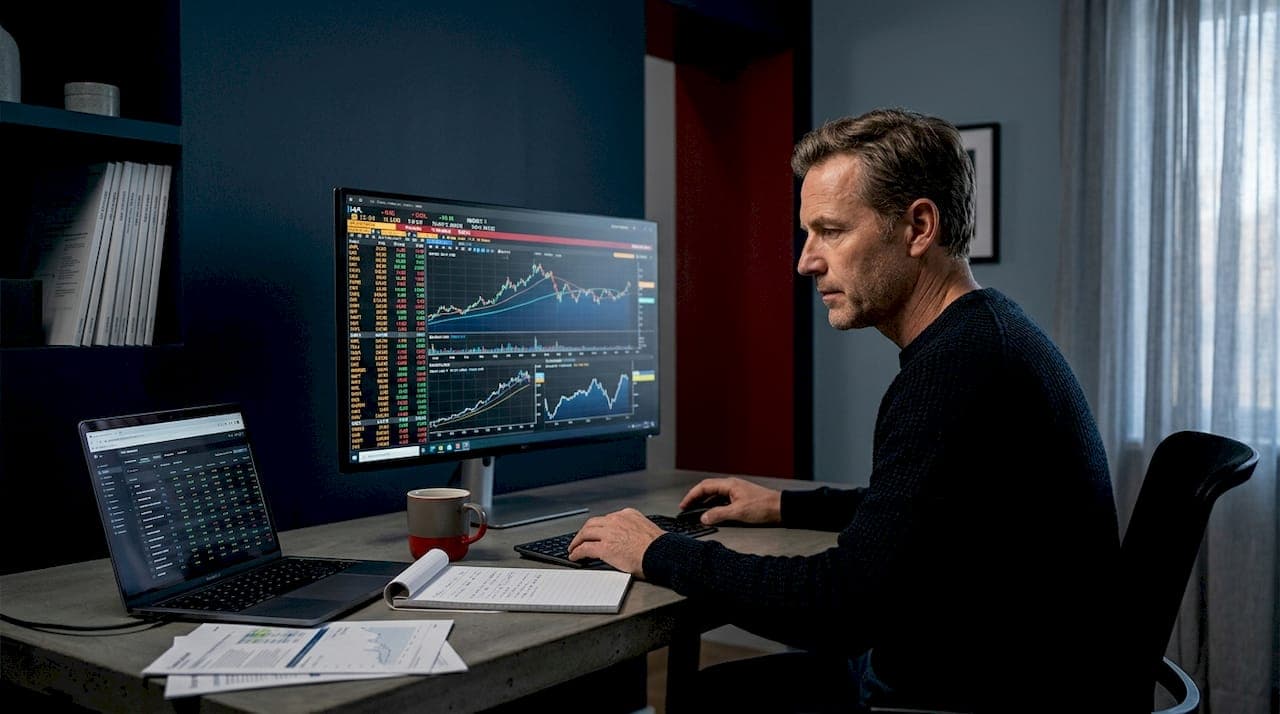
Stock discovery methods beyond apps are defined as the structured techniques, AI-powered workflows, open-source platforms, and alternative data systems investors use to identify stock candidates outside of standard mobile or retail trading applications. The industry term for this practice is "investment discovery," and it covers everything from quantitative screening to agentic AI research pipelines. Most retail investors rely on apps like Robinhood or Webull for ideas, but those tools surface the same popular names to millions of users simultaneously. The real edge comes from methods that go deeper: layered filters, live alternative data, and AI agents that combine fundamental, technical, and sentiment signals in seconds.
1. Advanced quantitative stock screening techniques
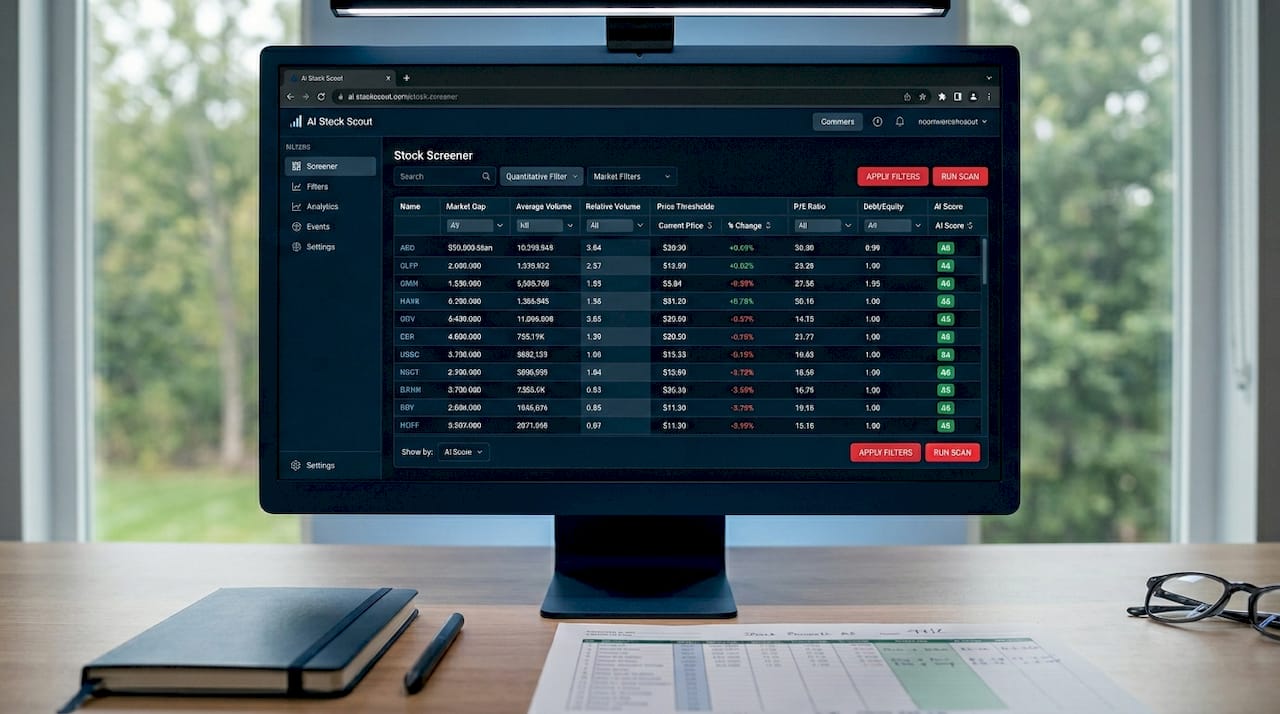
Quantitative screening is the foundation of every serious investment discovery strategy. Effective screening workflows use 4 to 6 layered quantitative filters to cut the investable universe by 80 to 90 percent, followed by 2 to 3 qualitative gates that produce a ranked watchlist. That structure matters because it forces you to eliminate first and analyze second, which is the opposite of how most app-based tools work.
The most productive filter sequences combine:
- Liquidity gates: Minimum average daily volume (e.g., 500K shares) and market cap floors to rule out untradeable names
- Valuation filters: Price-to-earnings, price-to-free-cash-flow, or EV/EBITDA thresholds calibrated to the sector
- Growth metrics: Revenue growth rate, earnings acceleration, or margin expansion over trailing quarters
- Technical conditions: Stocks trading above their 50-day or 200-day moving average to confirm trend alignment
- Quality screens: Return on equity above 15 percent or debt-to-equity below 1.0 to filter out structurally weak businesses
The key insight from Minalyst's 2026 screening research is that screens with fewer than 4 filters produce too many candidates, while more than 6 filters create false precision. False precision is the trap where you feel confident because your list is short, but the filters themselves were arbitrary. The goal is a shortlist of 10 to 20 names you can actually research deeply, not a list of 3 names that survived an overly rigid process.
Pro Tip: Build your screen to eliminate, not to select. If your screen returns fewer than 8 candidates, loosen one filter. If it returns more than 25, tighten one. Treat the output as a research queue, not a buy list.
| Filter type | Example threshold | Purpose |
|---|---|---|
| Liquidity | Avg. volume > 500K | Removes untradeable micro-caps |
| Valuation | P/E < 20 or sector median | Narrows to reasonably priced names |
| Growth | Revenue growth > 10% YoY | Focuses on expanding businesses |
| Technical | Price above 50-day MA | Confirms trend alignment |
| Quality | ROE > 15% | Filters structurally weak companies |
2. AI stock screener agents and natural language workflows
AI-powered discovery agents represent the most significant shift in stock screening techniques in the past decade. Conversational discovery platforms translate natural language queries into multi-factor scans that return filtered results within seconds, including sentiment inputs from Reddit and other social investment communities. You type "show me mid-cap tech stocks with accelerating revenue and bullish social sentiment," and the agent handles the filter logic automatically.
Platforms like Jenova AI and Toggle AI go further by combining:
- Fundamental filters (earnings growth, margins, balance sheet strength)
- Technical conditions (breakout patterns, relative strength)
- Sentiment data from Reddit, StockTwits, and financial news feeds
- Macro context overlays (sector rotation signals, interest rate sensitivity)
The deeper capability is agentic workflow execution. AI-led discovery agents run multi-step workflows covering screening, analysis, backtesting, and monitoring while retaining context across each cycle to produce risk-validated investment theses autonomously. That means the agent does not just filter. It tests the idea, checks historical performance, and flags risk factors before surfacing the candidate to you.
"An effective AI stock discovery agent combines natural language query processing with domain-specific screening agents to maximize speed and accuracy." — Jenova AI, 2026
This approach is particularly powerful for swing traders and long-term investors who want to cover more ground without hiring a research team. The speed advantage is real: what takes a manual analyst two hours of spreadsheet work takes an AI agent under a minute.
3. Open-source and local AI stock analysis platforms
Open-source platforms running locally on your own hardware are a growing category of non-app methods for stocks, especially for developers and technically capable retail investors. A fully local AI stock platform can combine AI research agents, professional screeners, strategy backtesting, and heatmaps in one interface without relying on any third-party API or cloud subscription.
The platform Equilima, built on Ollama's local large language model library, demonstrates what this looks like in practice. Key advantages include:
- No API rate limits: Cloud-based apps throttle your queries. Local execution removes that ceiling entirely.
- Full data privacy: Your watchlists, strategies, and research stay on your own infrastructure.
- Deep customization: You modify the screening logic, add proprietary data feeds, or integrate custom backtesting rules without waiting for a vendor to build the feature.
- Zero subscription dependency: Once set up, the core platform runs without monthly fees.
Local LLM execution also mitigates dependence on third-party app ecosystems, which matters when a platform changes its pricing or discontinues a feature you rely on. The tradeoff is setup complexity. These tools require comfort with command-line interfaces and basic Python environments.
Pro Tip: If you are a developer or power user, start with Equilima's GitHub repository and run it locally with a small-cap screener as your first test case. The learning curve is steep for the first week, then it becomes your most flexible discovery tool.
4. Alternative data integration for stock discovery
Alternative data is any non-traditional signal used to identify stock opportunities before they appear in standard financial metrics. SEC Form 4 insider filings are one of the most reliable alternative data sources. Aggregated insider buying trends across multiple executives at the same company carry far more signal than a single transaction, especially when combined with fundamental analysis.
Other high-value alternative data sources for stock discovery include:
- Social sentiment tracking: Aggregated mentions and sentiment scores from Reddit, Twitter/X, and StockTwits
- Job posting data: Rapid hiring in specific departments (e.g., sales or R&D) signals business expansion before earnings confirm it
- App download metrics: Rising downloads for a company's consumer app often precede revenue acceleration
- Dark pool prints: Large off-exchange block trades that suggest institutional accumulation
- Congressional trading disclosures: Trades filed by U.S. Congress members under the STOCK Act, which often precede sector-level moves
The practical value of alternative data is that it gives you a time advantage. By the time a company's growth shows up in quarterly earnings, most of the price move has already happened. Alternative signals let you identify the setup earlier in the cycle.
5. Real-time alerts as an investment discovery tool
Real-time alerting is not just a notification feature. It is a discovery method in its own right. Active trading screens must refresh more frequently than once per hour because edges can disappear in minutes. A screener that updates hourly is functionally useless for any trader working intraday setups.
The distinction between alert types matters significantly. Condition-based alerts that combine price and volume conditions reduce false positives and improve trade timing far better than simple price-only notifications. A price alert tells you a stock hit $50. A condition-based alert tells you a stock hit $50 on three times its average volume while crossing its 20-day moving average. Those are completely different signals.
For active traders, a well-designed stock notification system covers:
- Relative volume spikes above 2x the 20-day average
- Moving average crossovers on intraday timeframes
- Unusual options activity or dark pool prints above a set dollar threshold
- Earnings surprise alerts within minutes of a release
- Social sentiment velocity spikes (rapid increase in mention volume)
The combination of live data frequency and condition logic is what separates professional discovery workflows from what most retail apps offer. Most apps send you a price alert after the move has already happened.
6. Comparing non-app stock discovery methods by use case
Not every method fits every investor. The right approach depends on your time horizon, technical ability, and how much of your process you want to automate.
| Method | Best for | Technical skill needed | Cost range |
|---|---|---|---|
| Quantitative screening | Long-term and swing investors | Low to moderate | Free to $50/month |
| AI screener agents | All styles, especially swing | Low (natural language) | $30 to $200/month |
| Open-source local platforms | Developers, power users | High | Free (hardware cost) |
| Alternative data feeds | Swing and active traders | Moderate | $50 to $500/month |
| Real-time condition alerts | Active and day traders | Low to moderate | Free to $100/month |
Long-term investors get the most value from quantitative screening combined with insider flow tracking. Swing traders benefit most from AI agents layered with social sentiment and condition-based alerts. Active day traders need real-time data refresh rates and volume-based alert conditions above everything else. Developers and researchers who want full control and privacy should explore open-source platforms like Equilima.
Pro Tip: Do not pick one method and ignore the rest. The highest-conviction setups come from candidates that pass a quantitative screen AND show unusual insider buying AND trigger a volume alert. Convergence across methods is your signal quality filter.
Combining methods also addresses the core weakness of each approach in isolation. Quantitative screens miss narrative-driven momentum stocks. AI agents can overfit to recent sentiment. Alternative data requires context to interpret correctly. Layering them together creates a more complete picture than any single tool provides.
Key takeaways
The most effective stock discovery workflows combine quantitative screening, AI agents, alternative data, and real-time alerts rather than relying on any single method or app.
| Point | Details |
|---|---|
| Screen to eliminate, not select | Use 4 to 6 filters to cut the universe, then apply qualitative gates to rank the shortlist. |
| AI agents accelerate multi-factor discovery | Natural language workflows combine fundamentals, technicals, and sentiment in seconds. |
| Alternative data provides time advantage | Insider filings, job postings, and social sentiment signal moves before earnings confirm them. |
| Real-time alerts require condition logic | Combine price and volume conditions to reduce false positives and improve execution timing. |
| Method stacking raises conviction | Candidates that pass multiple independent methods carry stronger signal than single-source finds. |
Why I think most retail investors are still leaving edge on the table
I have spent years watching retail investors cycle through the same apps, frustrated that they keep seeing the same crowded trades. The problem is not the tools. It is the workflow. Most people treat stock discovery as a passive activity, something an app does for them in the background. The investors who consistently find better setups treat discovery as an active, multi-layered research process.
The shift I have seen work most reliably is moving from "what does the app show me today" to "what does my screen, my alert system, and my alternative data tell me together." When all three point at the same name, you have something worth spending real research time on. When only one points at it, you have noise.
I am also skeptical of the open-source route for most retail investors, not because the tools are bad, but because the setup cost is real. Equilima and similar platforms are genuinely powerful, but they reward people who enjoy tinkering. If that is not you, a well-configured AI agent platform with a solid alert layer gets you 80 percent of the benefit with 20 percent of the effort.
The discipline that matters most is not which tool you use. It is the habit of treating every screen output as a research queue, not a trade list. The screen finds the candidate. You still have to do the work to decide if it is worth owning.
— Philip
Discover smarter stock ideas with Ai-stockscout
If you are ready to move beyond basic apps, Ai-stockscout gives you the tools to do it without the complexity or the high price tag.
Ai-stockscout combines AI-powered stock scanning and screening with real-time alerts, insider flow tracking, dark pool data, social sentiment, and congressional trading disclosures in one platform. It is built specifically for retail investors and active traders who want professional-grade discovery without paying Trade Ideas or TrendSpider prices. The free plan is genuinely useful. The Pro upgrade costs significantly less than competing platforms and comes with a 3-day trial and easy cancellation. You can use it alongside your current investing app or replace it entirely. Start free today at ai-stockscout.com.
FAQ
What are stock discovery methods beyond apps?
Stock discovery methods beyond apps include quantitative screening workflows, AI-powered screener agents, open-source local platforms, alternative data feeds (insider filings, social sentiment, job postings), and real-time condition-based alert systems. These approaches go deeper than standard mobile apps by combining multiple data layers to surface higher-conviction candidates.
How many filters should a stock screen use?
Research from Minalyst shows that effective screens use 4 to 6 quantitative filters. Fewer than 4 produces too many candidates; more than 6 creates false precision that shrinks your list for the wrong reasons.
What is alternative data in stock research?
Alternative data refers to non-traditional signals like SEC Form 4 insider filings, app download metrics, job posting trends, dark pool prints, and social sentiment scores. These sources often signal price moves before they appear in quarterly earnings reports.
How often should an active trader's screener refresh?
Active trading screeners should refresh more frequently than once per hour. Setups can disappear in minutes, so real-time or near-real-time data is required for any intraday discovery workflow.
Are condition-based alerts better than price alerts?
Yes. Condition-based alerts that combine price and volume thresholds, such as a stock crossing a moving average on elevated relative volume, reduce false positives and improve trade timing compared to simple price-only notifications.